Speaking with structure and purpose
Apply the concepts in “Speaking with structure and purpose” to a guided exercise. Discuss your approach and use feedback to improve the final task.

College Students
Turn ideas into clear conversations and presentations. Students practise expressing a point, listening carefully and adapting their communication to academic and workplace situations.
LEARNING FOCUS
Communication Skills Training connects core concepts with guided application. The outline below is a discussion framework; the final syllabus is agreed for your learners.
Apply the concepts in “Speaking with structure and purpose” to a guided exercise. Discuss your approach and use feedback to improve the final task.
Apply the concepts in “Active listening and useful questions” to a guided exercise. Discuss your approach and use feedback to improve the final task.
Apply the concepts in “Presentation delivery and audience engagement” to a guided exercise. Discuss your approach and use feedback to improve the final task.
Apply the concepts in “Professional email and meeting etiquette” to a guided exercise. Discuss your approach and use feedback to improve the final task.
Apply the concepts in “Feedback, disagreement and teamwork” to a guided exercise. Discuss your approach and use feedback to improve the final task.
PRACTICE & FEEDBACK
A short presentation, a workplace role play and an email-writing task assessed against a clear rubric..
FOR YOUR INSTITUTION
College students across disciplines and levels of spoken confidence.
Workshop, modular course or institutional pathway. Hours and batch structure are agreed after the needs discussion.
Confirm prerequisites, trainer availability, venue, equipment and any specialist supervision needed for practical work.
Agree attendance, practical tasks, feedback and certificate terms in writing before delivery.
PROGRAM BACKGROUND
The ability to effectively communicate with other people is an important skill. Through communication, people reach some understanding of each other, learn to like each other, influence one another, build trust, get things done and learn more about themselves and how people perceive them. This course will reinforce the importance of their public relations role, highlight their influence and effect on others and raise their awareness of the key interpersonal skills essential for their success. Therefore Sieger has developed tools to improve the quality of student's to perform better in college campus during their academic life.
Communication Skills, students need basic communication skills, specific speaking and listening skills, interpersonal and group communication skills, communication codes, and listening competencies that will help them succeed in future courses and on the job. Students taking this course will be able to: Understand effective human communication techniques and processes. Develop and practice human communication skills, including skills in verbal, nonverbal, listening, critical thinking, small group and public speaking. Analyze and assess effective human communication. To help student’s overcome his natural shyness and nervousness. Explain how self – image affects one’s feelings, attitudes and behaviour. To improve the four skills (Listening, Speaking, Reading, and Writing) of the Students; To provide a venue for the Students to practice and hone their communication skills; Understanding self and others – Attitude Awareness and Apply communication techniques. Describe the steps in preparing presentation. To introduce the Students to the sound system of English language (vowel, consonants…) To provide the Students with common vocabulary (verbs, nouns, adjectives, adverbs…) and basic grammar (tenses, voices….) of English; Develop an all-round personality with a mature outlook while conversing with others Perform effectively thereby enhancing the brand image of the college. Identify the behavioural manifestations of self-discipline. Course Outline Introduction to Communication - Basic Communication Skills, Recognize when it is appropriate to communicate, Select the most appropriate and effective media for communicating, Determine the purpose of oral discourse, State ideas clearly, Communicate ethically, Accept responsibility for his/her communication behavior, Structure a message for effectiveness with in introduction - main points - useful transitions - and a conclusion, Accomplish communication goals, Employ vocal variety in rate, pitch and intensity, Articulate clearly, Employ language appropriate to the designated audience, Recognize the needs and concerns of a culturally diverse society, Recognize and explain the consequences of ethnocentrism, stereotypes, prejudice and bigotry, Demonstrate nonverbal behavior that supports the verbal message, Demonstrate appropriate interpersonal skills for various contexts, Display self-awareness as a communicator Communication Skills - Flow of Communication, Listening, Barriers of Communication, How to overcome barriers of communication, Build oratory skills, Difference between verbal & non-verbal communication, Overcoming roadblocks of communication, Role of listening, understanding & feedback, Apply the components of verbal communication to their speech, Respond to non-verbal cues in communication, Differentiate between styles of communication, Appreciate the way conversations can be made to work towards a win-win situation by using positive and assertive means of communication. Speech Communication Skills - Choose and narrow a topic, Adapt to chances in audience characteristics, Demonstrate credibility, Identify facts, issues and problems relevant to the topic, Support arguments with relevant and adequate evidence, Develop messages that influence attitudes - behaviors - and actions, Describe or express feelings to others when appropriate. Interpersonal and Group Communication Skills - Recognize when another does not understand their message, Identify and manage misunderstandings, Recognize when it is appropriate to speak, Feel and convey empathy towards others, Manage conflict, Maintain conversations by taking turns - managing interaction - reciprocal conversation - and selfdisclosure, Allow others to express different views, Effectively assert his/her views, Ask questions effectively, Listen attentively to questions and comments from other communicators, Answer questions concisely and to the point or issue, Be open-minded about another’s point of view, Work collaboratively as a team member, Keep group discussions relevant and focused, Value of win-win situation, Communicate effectively with assertion, Building rapport with people. Listening Competencies - Display literal listening competencies: Recognize main ideas - Identify supporting details - Recognize explicit relationships among ideas - Recall basic ideas and details - Attend with an open mind. Display critical comprehension competencies: Attend with an open mind - Perceive the speaker’s purpose and organization of ideas and information - Discriminate between statements of fact and statements of opinion - Distinguish between emotional and logical arguments - Detect bias and prejudice - Recognize the speaker’s attitude - Synthesize and evaluate by drawing logical inferences and conclusions - Recall implications and arguments - Recognize discrepancies between the speaker’s verbal and nonverbal messages - Employ active listening techniques when appropriate. Personality Grooming - Inner Personality Development, Role of motivation & body language, Filling the GAP- Grooming, Attitude, Personality. Course Duration Option 1: 30 Hours i.e., 5 day Workshop Option 2: 48 Hours i.e., 8 Days Workshop (for Optimum Result) Some salient features of the program Uniqueness in Methodology. It is an intensive but a flexible program designed to suit participants with varied learning patterns. Uses sharing and reflecting on experiences of the participants as the major learning tool. Program have clear metrics for measuring the effectiveness. Is not designed to generate agreement but reactions It helps the student’s to take part effectively in various selection procedures adopted by the recruiters. Methodology Real-World Experience Simulation between Facilitator & Participants. Participants will be led in a Directed Learning Mode, not Just with Facilitator’s one-sided Lectures. Combination of Presentations and Examples from Facilitator and Interactive / Hands-On Participants’ Exercises with Individual / Group Report-Outs. Experiential workshop environment where participants will be educated to take risks and make adjustments based on their results from Role-Plays before approaching large real-time projects. Download PDF
Brochures are retained from the original website. Confirm the current scope and terms when enquiring.
YOUR QUESTIONS
College students across disciplines and levels of spoken confidence.
Speaking with structure and purpose, Active listening and useful questions, Presentation delivery and audience engagement, Professional email and meeting etiquette, Feedback, disagreement and teamwork.
Discuss a workshop, a modular course or a longer institutional pathway. The delivery mode, hours and trainer availability are confirmed in your proposal.
A short presentation, a workplace role play and an email-writing task assessed against a clear rubric.. Assessment criteria and the feedback format are agreed before delivery.
Yes. Share the batch profile, current skill level, language preferences and learning objectives so the proposed activities and examples can be adapted.
Requirements depend on the final learning plan. Confirm room layout, display and audio equipment, devices, software, workshop space or outdoor arrangements before booking.
Certificate availability, the issuing organisation, attendance requirement and assessment criteria must be confirmed in the proposal. No external accreditation or professional licence is implied.
Email info@siegergroups.com with your institution name, communication skills training requirement, learner profile, batch size, preferred dates and location.
CONTINUE EXPLORING
College Students
Build a practical bridge between academic learning and the recruitment process. Students practise presenting their experience, working through selection tasks and responding to interview questions with clarity.
Explore the program
College Students
Help students approach recruitment assessments with stronger fundamentals, deliberate practice and a clear strategy for managing time.
Explore the program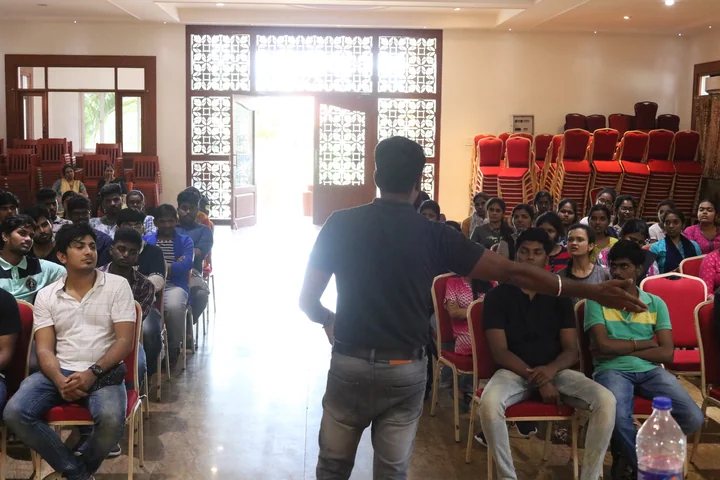
College Students
Help students understand their strengths, organise their effort and behave professionally in shared tasks. The programme connects self-awareness with practical decisions, communication and a realistic career development plan.
Explore the programLET’S BUILD YOUR LEARNING PLAN
Tell us the audience, learning priorities, batch size and preferred dates. Let’s shape the next step together.
ENQUIRE WITH SIEGER ACADEMY
Share your institution, learner profile, training priorities and preferred dates. We’ll discuss a programme that fits your students and academic calendar.
Enquiries are handled through our Academy form. Privacy information